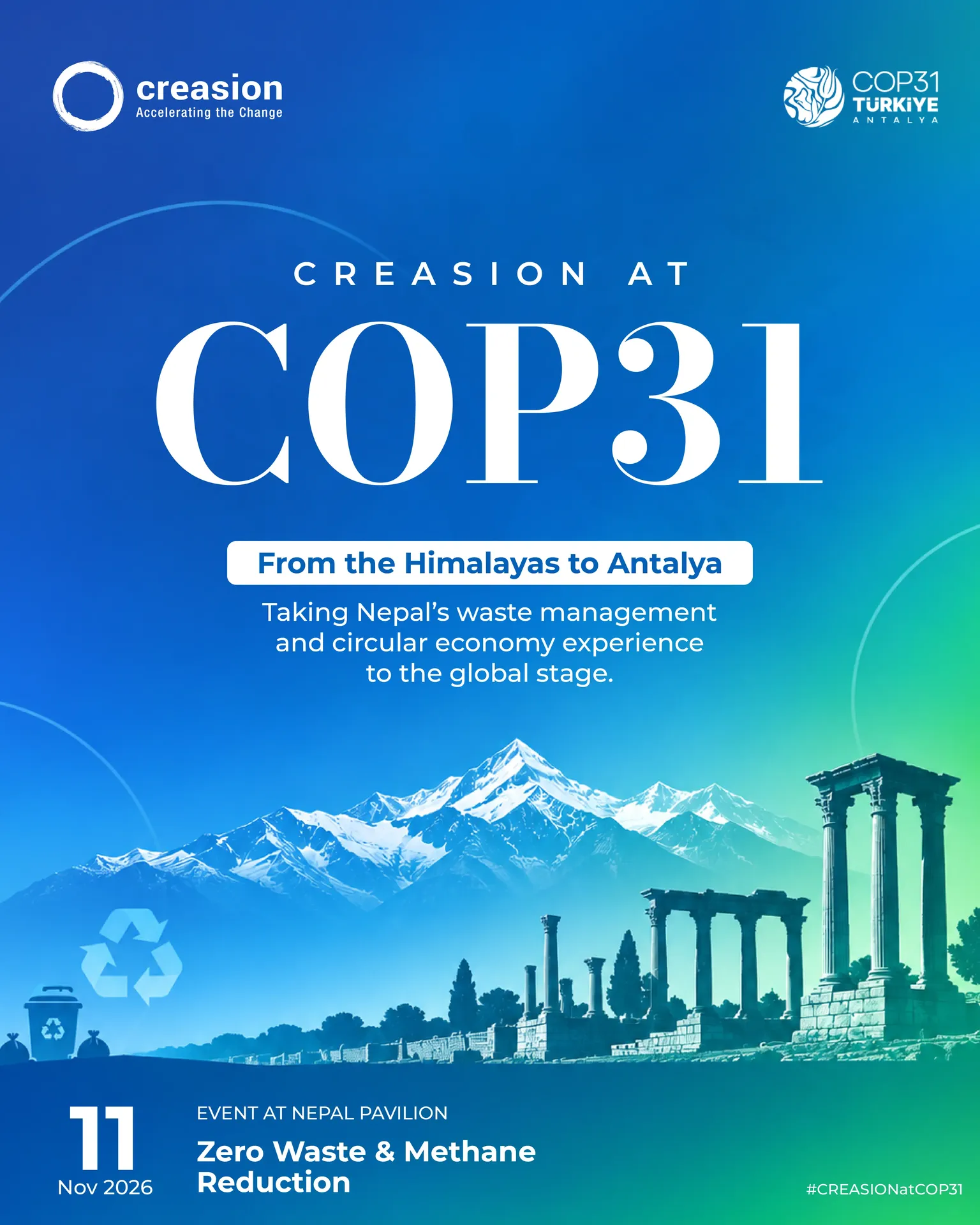
As the world comes together for COP31, it is time to recognise that the path to climate action does not lie solely in energy transitions and emissions targets. It also lies in how we produce, consume, use and manage the resources around us.
Waste is often treated as a local environmental problem, as a matter of municipal collection, overflowing landfills, polluted rivers and littered streets. However, its implications go beyond the places where waste is generated or discarded. Waste is a climate issue, and the way societies manage their resources has significant consequences for greenhouse gas emissions, ecosystem health and the resilience of communities.
As global attention turns towards climate action at the 31st United Nations Climate Change Conference (COP31), the inclusion of Zero Waste in the climate conversation is an opportunity to rethink how waste is understood and addressed. Zero Waste must not be perceived as an isolated environmental objective. It needs to become an integral part of national climate strategies, urban planning and sustainable development.
The Climate Cost of What We Throw Away
The climate impact of waste begins way before something reaches a landfill. The extraction of raw materials, manufacturing, transportation, consumption and eventual disposal all carry an environmental cost. In fact, the extraction, production, transportation and disposal of materials contribute to approximately 70% of global greenhouse gas emissions. This highlights an important reality: our climate footprint is closely connected to the materials we use and the systems through which they move.
The waste sector itself is a significant source of methane emissions. When organic materials such as food scraps, garden waste, paper and cardboard decompose in oxygen-deprived landfill environments, they release methane, a greenhouse gas with a global warming potential more than 80 times that of carbon dioxide over a 20-year period. Globally, the waste sector accounts for approximately 20% of human-driven methane emissions.
This makes waste management particularly important in the context of near-term climate action. Reducing methane emissions offers an opportunity to slow the pace of global warming, while preventing waste generation and recovering materials can reduce emissions across entire production and consumption cycles.
Yet, the prevailing approach in many parts of the world remains largely linear: extract, produce, consume and discard. This model not only places increasing pressure on natural resources but also perpetuates emissions at every stage. The challenge, therefore, is not simply to manage the waste we generate more efficiently, but to question why so much waste is generated in the first place.
Nepal's Waste Challenge Is Also a Climate Challenge
For Nepal, this conversation is urgent.
As one of the countries highly vulnerable to climate change, Nepal is already experiencing the consequences of rising temperatures, changing rainfall patterns, floods, landslides and other climate-related hazards. While national climate discussions frequently focus on energy, forests, agriculture and disaster risk reduction, waste management remains comparatively underrepresented as a climate intervention.
At the same time, rapid urbanisation, population growth and changing consumption patterns are increasing the volume and complexity of municipal waste. Current estimates suggest that Nepal generates approximately 4,900 tonnes of solid waste daily, with plastic accounting for around 16% of municipal waste. Across municipalities, waste management systems continue to face persistent challenges, including inadequate collection infrastructure, limited source segregation, insufficient recycling facilities and continued dependence on landfills and open dumping.
The composition of municipal waste also reveals a significant opportunity. Approximately 60–70% of Nepal's municipal waste stream is biodegradable organic material. This means that a substantial proportion of what currently ends up in disposal sites could instead be composted, processed and returned to productive use.
The consequences of inadequate waste management are not limited to emissions. Plastics and other discarded materials clog drainage systems, increasing the risk of urban flooding during heavy rainfall. Open dumping and burning contribute to air, soil and water pollution, while unmanaged waste creates public health risks for communities. These impacts are particularly concerning for vulnerable populations, including informal waste workers and communities living near disposal sites.
In this context, waste management cannot be separated from climate resilience, public health or urban development. Addressing one without considering the others risks overlooking a significant part of the climate challenge.
From Waste Disposal to Resource Management: The Zero Waste Approach
A Zero Waste approach challenges the assumption that waste is an inevitable by-product of development. Instead, it recognises discarded materials as resources that can be prevented from becoming waste in the first place.
This requires a shift away from the conventional disposal-oriented model towards a circular system that prioritizes prevention, redesign, reuse, repair, recycling, composting and resource recovery.
The distinction is important. Improving collection and expanding landfill capacity may address immediate waste management pressures, but neither fundamentally reduces the amount of waste generated. A circular approach addresses the problem further upstream by reducing unnecessary consumption, extending the useful life of products and ensuring that materials remain in circulation for as long as possible.
The climate benefits are substantial.
Preventing organic waste from reaching landfills reduces methane emissions. Composting can return nutrients to agricultural soils, improve soil quality and enhance water retention. Recycling reduces dependence on virgin raw materials and the energy-intensive processes required to produce them. Reusing and repairing products further reduces the demand for new materials, while reducing plastic pollution can help keep drainage systems and waterways clear.
Zero Waste, therefore, offers a dual climate benefit: it contributes to mitigation by reducing emissions and supports adaptation by strengthening the environmental and economic resilience of communities.
Importantly, it also creates opportunities for green employment. Recycling enterprises, composting facilities, repair businesses and resource recovery initiatives can support local economies while generating livelihoods. For a country like Nepal, with a young workforce and growing demand for employment opportunities, the transition towards circularity is also an opportunity to build a more inclusive green economy.
The Missing Link: Turning Climate Commitments into Local Action
Despite the potential of Zero Waste, the transition cannot happen through individual behaviour change alone.
Waste management is a systemic issue that requires coordinated action across governments, municipalities, businesses, producers, development partners and communities. Households can segregate waste, but segregation has limited value if separate collection systems do not exist. Recycling initiatives can recover valuable materials, but their sustainability depends on reliable markets, adequate infrastructure and supportive policies. Similarly, municipalities cannot independently deliver circular waste systems without sufficient financial resources, technical capacity and institutional coordination.
This is where climate policy and financing become critical.
National climate commitments and local adaptation plans must recognise waste reduction, methane prevention, composting and material recovery as legitimate climate interventions. Municipalities need greater technical and financial support to establish decentralised waste management systems, improve source segregation and strengthen recycling infrastructure. Businesses and producers must also take greater responsibility for the materials they introduce into the market, including through product redesign, reduced packaging and extended producer responsibility.
Equally important is the recognition of informal waste workers, who already play a critical role in recovering and recycling materials. A transition towards Zero Waste must ensure that these workers are not displaced by formalisation, but instead benefit from safer working conditions, social protection, fair compensation and opportunities to participate in the emerging circular economy.
Climate finance must also reflect this broader understanding of climate solutions. Investments in waste management should not be viewed merely as municipal service expenditure. They are investments in emissions reduction, public health, climate resilience, resource efficiency and green livelihoods.
For Nepal, where access to climate finance remains a significant challenge, Zero Waste offers an opportunity to pursue practical, locally driven climate interventions that can deliver multiple development benefits simultaneously.
A Call to Action: Accelerating Towards Zero Waste
As COP31 brings together governments, climate institutions, businesses and civil society, the conversation must extend beyond setting ambitious climate targets. It must also address the systems that determine whether those targets can be achieved.
Zero Waste deserves a stronger place in this conversation.
Governments must integrate circular economy principles and waste-related methane reduction into climate policies and national commitments. Local governments must move beyond collection and disposal towards comprehensive systems for segregation, composting, recycling and resource recovery. Businesses must rethink production and packaging practices, while development partners and climate financiers must invest in the infrastructure, innovation and local institutions required to make circular systems viable.
For Nepal, this transition is not an abstract ambition for the future. It is an opportunity to address a growing urban challenge while contributing to climate mitigation, strengthening community resilience and creating green economic opportunities.
At CREASION (Center for Research and Sustainable Development Nepal), our work on waste management and circular economy initiatives reflects the belief that environmental challenges must be addressed through solutions that connect communities, local governments, businesses and the wider development ecosystem. Our engagement in this space is grounded in the understanding that waste is not merely something to be collected and discarded; it is a resource that, when managed responsibly, can contribute to sustainable development and climate action.
The transition to Zero Waste will not happen overnight, nor can it be achieved by any single institution. It requires a fundamental shift in how we value resources, design our economies and define progress.
The question is no longer whether we can afford to transition towards Zero Waste. It is whether we can afford not to.
| As the world accelerates towards its climate goals, we must also accelerate towards Zero Waste. Because a climate-resilient future cannot be built on a system that continues to produce, consume and discard without consequence. |