
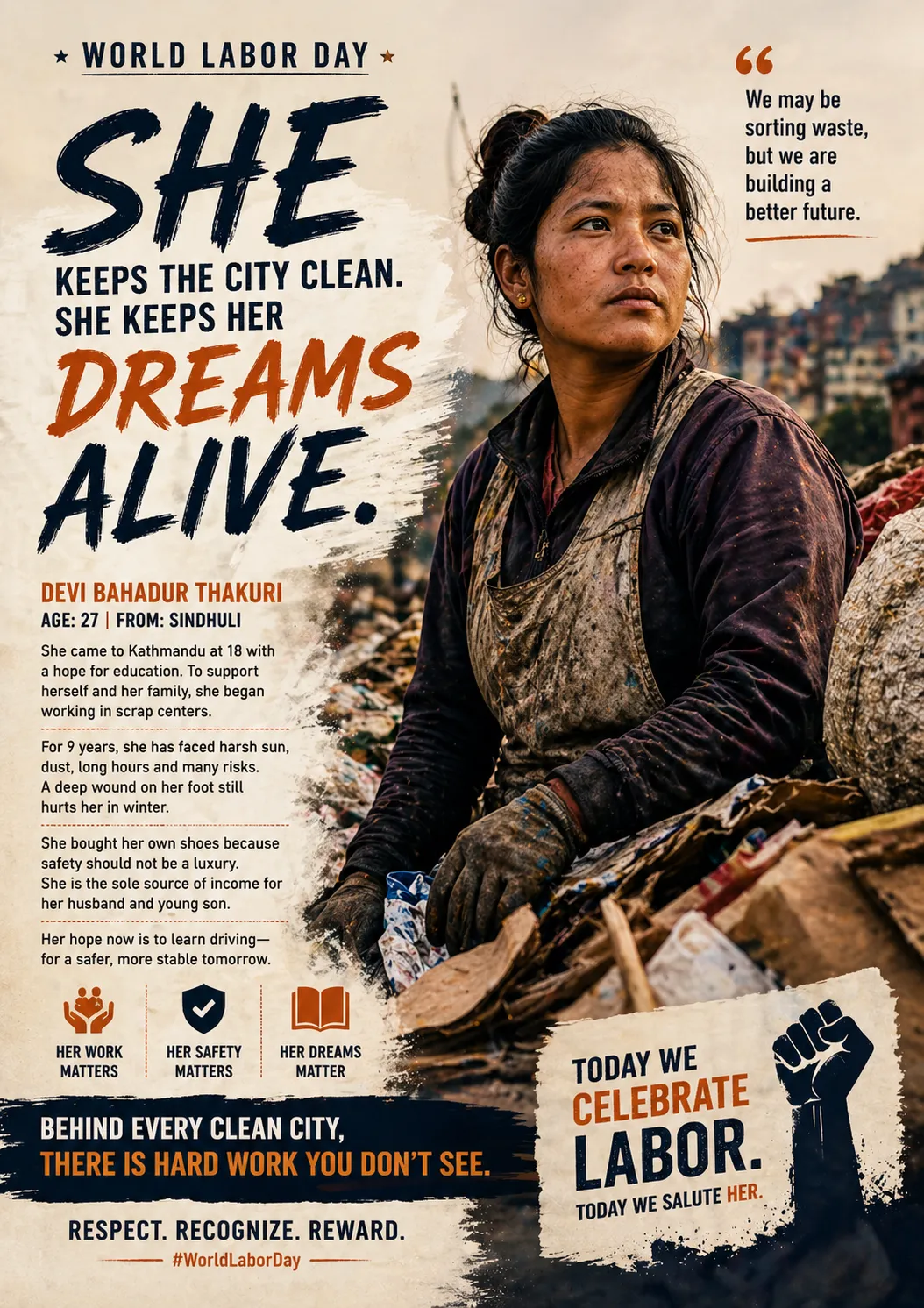
On this International Labors' Day, her story does not arrive polished. It comes with dust under its nails, with a limp that worsens in winter, with a silence learned out of necessity.
Devi Maya did not come to Kathmandu to become a waste worker.
She came with a notebook.
At eighteen, she carried a hope so fragile it could have been mistaken for naivety—the belief that education could change the direction of her life. From Sindhuli to the restless edges of Kathmandu, she arrived alone, unannounced, and unseen. Like so many girls from small towns, she came not just to study, but to survive.
She enrolled in a government school. Sat in classrooms. Held onto words like future, possibility, change.
But hope does not pay rent.
Soon, survival began to interrupt her education. Work slipped in where dreams once sat. Scrap centers became her classrooms. The city, her reluctant teacher.
At eighteen, she learned how to sort through waste before she learned how to finish her studies.
Now, at twenty-seven, nearly a decade has passed.
Nine years of bending over piles of what the city throws away. Nine years of inhaling dust, of working through hunger, of enduring heat that presses down like a hand that will not lift. In the beginning, her body did not protest. Youth rarely does.
But time remembers.
Now her body carries its own archive of labor ;aches that linger, exhaustion that no longer disappears overnight. There is a wound on her left toe, from years ago. Deep. Careless. Unnoticed by anyone but her. It healed the way most things in her life do—partially.
In winter, it returns. Quiet, persistent. A reminder.
She bought herself a pair of shoes. Not because she wanted to—but because she had to. Protection, in her world, is something you earn, not something you are given. She knows safety gear should be provided. She knows she deserves it.
But she does not ask.
Because asking is risky.
And she cannot afford to lose this job.
She is the only one earning, for her husband, for her young son, for a family that depends on her strength staying intact. So she continues. Carefully. Quietly.
And yet, there is still something inside her that refuses to disappear.
She wants to learn driving.
It sounds small. Almost ordinary. But for her, it is a doorway. A shift from carrying weight to controlling direction. From the ground to the road. From endurance to possibility.
On this day, when the world celebrates labor in speeches and banners, her story remains in the margins.
But it is stories like hers that hold cities together.
Not loudly. Not visibly. But persistently.
She is not just a worker.
She is unfinished hope.


